

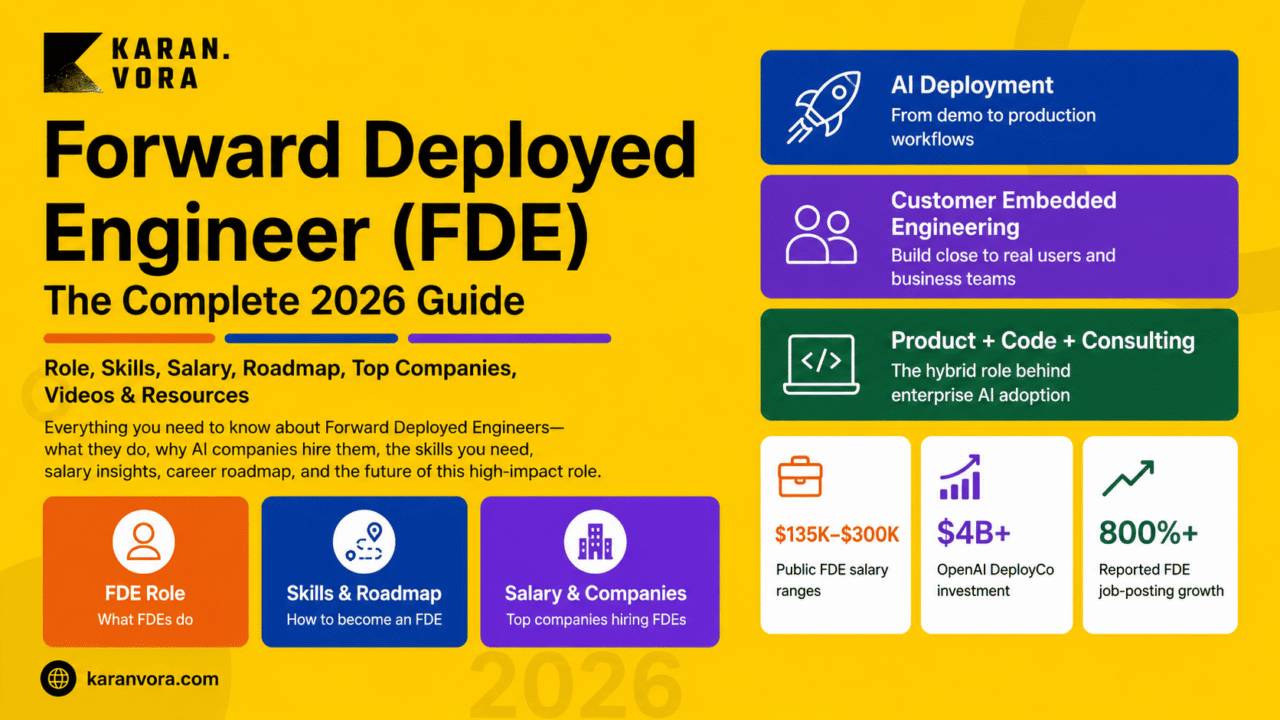
Forward Deployed Engineer: The Complete Guide to the FDE Role in the AI Era
A practical, research-backed guide to what a Forward Deployed Engineer does, why AI companies are hiring FDEs, which skills matter, how much FDEs can earn, and how to become one.
Short answer: A Forward Deployed Engineer, or FDE, is a technical builder who works directly with customers, business teams, operators, and end users to design, build, integrate, and deploy software in real-world environments.
Unlike a traditional software engineer who usually builds a reusable product from inside the company, a Forward Deployed Engineer goes much closer to the customer’s actual workflow and makes the technology work in production.
The easiest way to understand the role is this: a Forward Deployed Engineer is where software engineering, solution architecture, product thinking, consulting, customer success, and business transformation meet.
The role became famous because of Palantir, which popularized the Forward Deployed Software Engineer model. Palantir describes its Forward Deployed Software Engineers as people who work side by side with customers, understand their hardest problems, architect solutions, and build applications using business-critical data and AI.
In 2025 and 2026, the term exploded again because AI companies realized something important: powerful AI models are not enough. Enterprises do not just need access to models. They need people who can connect models to data, workflows, permissions, tools, compliance, and measurable business outcomes. That is exactly where the Forward Deployed Engineer fits.
OpenAI’s Forward Deployed Engineer role is focused on leading complex end-to-end deployments of frontier models in production, including discovery, technical scoping, system design, build, and rollout with strategic customers. You can see OpenAI’s current FDE-related openings on its career search page.
What Is a Forward Deployed Engineer?
A Forward Deployed Engineer is a software engineer who is deployed “forward” into the customer’s environment. This does not always mean physically sitting in the client’s office, although travel and on-site work can be part of the role. It means the engineer works close to the customer’s real problem, real users, real data, real systems, and real business constraints.
A traditional engineer may receive a Jira ticket and build a feature. An FDE may sit with the customer, understand why the workflow is broken, map the data sources, design the architecture, write production code, test it with users, deploy it, measure adoption, and then bring learnings back to product and research teams.
Palantir’s own explanation captures the difference well: a traditional software engineer may focus on creating one capability for many customers, while an FDSE focuses on enabling many capabilities for one customer. Read Palantir’s article here: A Day in the Life of a Palantir Forward Deployed Software Engineer.
A good FDE can answer questions like:
- What is the real business problem?
- Which workflow should be automated first?
- Which data sources are needed?
- Which system should the product integrate with?
- What should be built custom versus reused?
- How do we ship quickly without breaking security or reliability?
- How do we prove that the deployment created measurable impact?
That is why the role is becoming so important in enterprise AI.
Why Forward Deployed Engineers Are Becoming So Important
The rise of FDEs is directly connected to the gap between AI demos and AI production.
Many companies can now build impressive AI prototypes. But turning those prototypes into reliable systems that employees use every day is much harder. AI has to work with messy enterprise data, security rules, legacy tools, industry-specific workflows, approvals, audit logs, and human adoption. That is where many AI projects fail or get stuck.
OpenAI’s May 2026 launch of the OpenAI Deployment Company shows how serious this shift has become. OpenAI said the new company is designed to help organizations build and deploy AI systems they can rely on every day, with Forward Deployed Engineers embedded into organizations to solve complex problems in demanding environments.
Reuters also reported that OpenAI created the new unit with more than $4 billion in initial investment and acquired Tomoro, bringing approximately 150 AI engineers and deployment specialists into the new initiative. Read Reuters’ report here: OpenAI creates new unit with $4 billion investment to aid corporate AI push.
This is not just OpenAI. Anthropic, Databricks, Salesforce, Palantir, Cohere, and many AI-native companies are building similar customer-embedded technical teams.
Salesforce reported that Forward Deployed Engineer job postings grew more than 800% between January and September 2025, citing analysis by Indeed and the Financial Times. Salesforce also committed to building a team of 1,000 FDEs. Read Salesforce’s explanation here: What Is a Forward Deployed Engineer?
Key takeaway: Companies are moving from “AI experimentation” to “AI deployment.” That requires engineers who can build inside real business environments.
What Does a Forward Deployed Engineer Do?
A Forward Deployed Engineer usually owns the full path from problem discovery to production deployment.
In OpenAI’s FDE-style descriptions, the engineer owns technical delivery from first prototype to stable production, builds full-stack systems, embeds with customer teams, scopes work, removes blockers, contributes directly in code, codifies playbooks, and shares feedback that affects product and model roadmaps.
In practice, an FDE may do work like:
Discovery & Strategy
- Understand customer workflows
- Run technical discovery sessions
- Map business problems to technical solutions
- Define success metrics
Architecture & Integration
- Map data sources and APIs
- Design solution architecture
- Connect with CRMs, ERPs, data warehouses, and internal tools
- Handle security and governance requirements
Engineering & Deployment
- Write backend, frontend, data, or AI application code
- Build dashboards, internal tools, and AI workflows
- Deploy systems into production
- Debug real-world production issues
Adoption & Feedback
- Train users and customer teams
- Measure adoption and business impact
- Turn repeated learnings into product feedback
- Create reusable deployment playbooks
At Databricks, AI FDE work includes helping customers build and productionize first-of-its-kind AI applications, working across GenAI, LLMOps, RAG, multi-agent systems, Text2SQL, fine-tuning, and production-grade AI deployments. You can see an example role here: Databricks AI Engineer - FDE.
At Anthropic, Forward Deployed Engineers embed with strategic customers, build production applications with Claude models, deliver technical artifacts like MCP servers, sub-agents, and agent skills, support enterprise deployment, and identify repeatable patterns that can feed back into product and engineering. Example listing: Anthropic Forward Deployed Engineer, Applied AI.
So the FDE is not only an implementation engineer. The FDE is often the person who converts a company’s abstract AI ambition into a working production system.
FDE vs Software Engineer
A normal software engineer typically builds product features for a broad user base. A Forward Deployed Engineer builds closer to a specific customer’s environment.
A software engineer may optimize for clean architecture, scalability, code quality, and long-term product maintainability. An FDE also cares about those things, but must additionally optimize for business impact, customer adoption, speed of deployment, workflow fit, and stakeholder trust.
| Area | Traditional Software Engineer | Forward Deployed Engineer |
|---|---|---|
| Main focus | Build reusable product features | Build and deploy solutions inside customer reality |
| Primary environment | Internal engineering/product team | Customer workflows, data, users, and business systems |
| Success metric | Quality, scalability, maintainability, feature adoption | Business impact, production usage, customer outcome, deployment success |
| Communication | Mostly technical/product stakeholders | Engineers, executives, operators, business teams, and end users |
| Work style | More structured roadmap and tickets | More ambiguous, fast-moving, customer-driven work |
The core difference is simple:
A software engineer asks, “How do we build the product correctly?” A Forward Deployed Engineer asks, “How do we make this technology create value in this customer’s reality?”
This does not make FDEs less technical. In many companies, the FDE role is highly technical. Palantir requires strong coding ability in languages such as Python, Java, C++, TypeScript, or JavaScript, and expects FDSEs to work on architecture, data, AI, custom applications, and customer-facing delivery.
FDE vs Solutions Engineer
A Forward Deployed Engineer can look similar to a solutions engineer, but the two are not identical.
A solutions engineer usually supports sales, demos, pre-sales technical validation, proofs of concept, and customer education. Some solutions engineers also build integrations, but many do not own production engineering end to end.
An FDE usually goes deeper. They may work after the sale, inside the customer’s environment, and own production implementation. They write code, connect systems, debug deployment issues, and bring product feedback back to the core engineering team.
| Role | What it usually means |
|---|---|
| Solutions Engineer | Helps customers understand, evaluate, and adopt the product. |
| Forward Deployed Engineer | Helps customers turn the product into a working system inside their business. |
Salesforce explains that FDEs are technical architects and primary coders who design, build, and deploy agents, often in pods with deployment strategists. That is why the role is closer to production engineering than simple pre-sales support.
Why AI Companies Need FDEs
AI products are different from traditional SaaS products.
A CRM, payment tool, or project management app may work mostly the same across customers. But AI systems behave differently depending on the customer’s data, prompts, workflows, evaluation methods, risk tolerance, and users.
That means AI deployment is not plug-and-play. It is more like transformation engineering.
An AI FDE may need to:
- Build a RAG system over internal documents
- Connect LLMs to CRMs, ERPs, support tools, data warehouses, or internal APIs
- Create secure agentic workflows
- Build evals to measure model quality
- Design human-in-the-loop approval systems
- Handle hallucination, latency, permissions, privacy, and auditability
- Train teams to use the system
- Measure cost, accuracy, adoption, and ROI
This is why a16z argued that AI startups should not avoid services-heavy implementation work too early. Its analysis says that successful AI companies may need to embrace implementation, support, and integration work to own the system of work, capture valuable data, and solve genuine business problems.
Skills Required to Become a Forward Deployed Engineer
A strong FDE needs a rare combination of technical skill, communication ability, business understanding, and high ownership.
1. Software Engineering
You need to be able to write production code. Depending on the company, this may include Python, TypeScript, JavaScript, Java, C++, SQL, React, APIs, cloud platforms, backend systems, frontend interfaces, data pipelines, and DevOps.
Palantir specifically looks for strong coders with proficiency in languages such as Python, Java, C++, TypeScript, or JavaScript. You can review one of Palantir’s FDSE job descriptions here: Palantir Forward Deployed Software Engineer.
2. AI and Data Engineering
For AI FDE roles, you should understand LLMs, RAG, vector databases, evaluation frameworks, agents, prompt engineering, fine-tuning, model deployment, security, and monitoring.
Databricks looks for experience building GenAI applications including RAG, multi-agent systems, Text2SQL, fine-tuning, and production-grade GenAI deployments.
3. Customer Communication
An FDE must communicate clearly with engineers, product teams, executives, operators, and non-technical stakeholders.
This is important because the FDE is often the bridge between what the business wants, what users actually need, and what engineering can reliably ship.
4. Business Acumen
A good FDE does not blindly build what the customer asks for. They understand why the customer is asking for it.
The customer may request a dashboard, but the actual problem may be a broken approval workflow. They may ask for an AI chatbot, but the actual business need may be a knowledge retrieval system with human approval.
5. Problem Solving Under Ambiguity
FDE work is messy. Requirements change. Data is incomplete. Stakeholders disagree. Security blocks progress. The model performs well in one case and fails in another.
That is why high agency is one of the biggest traits of a great FDE.
Forward Deployed Engineer Salary
FDE compensation can be high because the role requires engineering depth, customer-facing ability, business understanding, and deployment ownership.
| Company / Source | Role | Publicly listed salary range | Link |
|---|---|---|---|
| Palantir | Forward Deployed Software Engineer | $135,000 to $200,000 per year, excluding potential bonuses, RSUs, and long-term incentives | View role |
| Anthropic | Forward Deployed Engineer, Applied AI | $200,000 to $300,000 USD in one public listing | View role |
| Databricks | AI Engineer - FDE | Varies by region and role; public listing describes AI deployment responsibilities | View role |
These ranges vary by location, seniority, company stage, equity, travel requirements, and whether the role is closer to AI engineering, deployment consulting, enterprise architecture, or strategic customer delivery.
For India-based engineers, global remote AI FDE roles are especially interesting because companies like Databricks have listed AI FDE roles that can be remote in India.
How to Become a Forward Deployed Engineer
Here is a practical roadmap.
Step 1: Become strong in software engineering
Start with backend and full-stack fundamentals. Learn Python, TypeScript, APIs, databases, authentication, deployment, cloud basics, and frontend frameworks like React.
Step 2: Build data and AI deployment skills
Learn SQL, data pipelines, vector databases, RAG, LLM APIs, prompt engineering, evaluation frameworks, observability, and cost optimization.
Step 3: Learn how businesses actually work
Pick one or two industries such as finance, healthcare, manufacturing, retail, logistics, gaming, or eCommerce. Understand workflows, bottlenecks, compliance, data systems, and business KPIs.
Step 4: Build proof-of-work projects
Do not only build toy AI apps. Build projects that look like real FDE work:
- An AI support agent connected to a knowledge base
- A sales workflow automation using CRM data
- A RAG system with evals and source citations
- An internal operations dashboard
- A document-processing workflow with human approval
- A multi-agent workflow for research, reporting, and task execution
- A secure enterprise chatbot with permissions and audit logs
Step 5: Practice customer discovery
Learn how to ask better questions:
- What workflow is slow today?
- Who owns the process?
- Which system stores the data?
- What does success look like?
- What breaks if the AI is wrong?
- Who approves the output?
- How will users adopt it?
- Which metric should improve?
Step 6: Learn to write deployment notes
FDEs need to communicate. Document your architecture, trade-offs, assumptions, risks, rollout plan, and success metrics.
Step 7: Apply for roles with the right keywords
Search for titles like:
- Forward Deployed Engineer
- Forward Deployed Software Engineer
- AI Forward Deployed Engineer
- Deployment Engineer
- Technical Deployment Lead
- Applied AI Engineer
- Customer Engineer
- Solutions Architect
- AI Solutions Engineer
- Agentic AI Engineer
The Future of FDEs
The FDE role is likely to become one of the most important roles in AI transformation.
In the SaaS era, companies hired solution architects and customer success teams to help customers adopt software. In the AI era, adoption is harder because AI must be connected to workflows, data, permissions, evaluations, and operating models.
That means the best AI companies will not only sell models. They will deploy outcomes.
Palantir has already productized part of this idea with AI FDE, an AI-powered forward deployed engineer inside Foundry that can translate natural language requests into platform operations such as data transformations, code repository work, ontology updates, functions, governance checks, and React applications.
This is a powerful signal. The future may include both human FDEs and AI-assisted FDEs. Human FDEs will handle judgment, stakeholder alignment, business context, architecture, risk, and adoption. AI FDE tools will accelerate implementation, documentation, code generation, testing, and platform operations.
So, the role may evolve into something even broader:
- AI Transformation Engineer
- Customer-Embedded AI Engineer
- Agentic Systems Engineer
- Deployment Architect
- AI Operating Model Engineer
But the core idea will remain the same: the best engineer is not always the one sitting far from the customer. Sometimes, the best engineer is the one closest to the real problem.
Best Videos to Understand FDEs
These videos are useful for understanding the role, its origin, and its evolution in the AI era.
Best Resources to Read
These are the strongest resources to understand Forward Deployed Engineering deeply:
- OpenAI Forward Deployed Engineer career search
- OpenAI launches the OpenAI Deployment Company
- Reuters: OpenAI creates new unit with $4 billion investment
- Palantir Forward Deployed Software Engineer job description
- Palantir: A Day in the Life of a Forward Deployed Software Engineer
- Palantir AI FDE overview
- Anthropic Forward Deployed Engineer, Applied AI
- Databricks AI Engineer - FDE
- Salesforce: What is a Forward Deployed Engineer?
- a16z: Services-led growth and AI implementation
FAQs About Forward Deployed Engineers
What is a Forward Deployed Engineer?
A Forward Deployed Engineer is a software engineer who works close to customers or end users to design, build, integrate, and deploy technical solutions in real-world environments. In AI companies, FDEs often connect models to customer data, workflows, systems, and measurable business outcomes.
What does FDE stand for?
FDE usually stands for Forward Deployed Engineer. At Palantir, the similar title is often Forward Deployed Software Engineer or FDSE.
Is a Forward Deployed Engineer a real engineer?
Yes. In strong companies, FDEs are highly technical. They write production code, design systems, build integrations, deploy applications, and solve engineering problems. The difference is that they also work directly with customers and business stakeholders.
Is FDE the same as a consultant?
No. An FDE may do consulting-style discovery, but the role is usually more technical and hands-on. An FDE does not only advise. An FDE builds, ships, deploys, and improves systems.
Is FDE a good career?
Yes, especially for engineers who enjoy coding, customer interaction, business problems, fast execution, and AI deployment. It may not be ideal for someone who wants to only write code in isolation without customer or stakeholder exposure.
What skills do you need to become an FDE?
You need software engineering, data or AI skills, communication, business understanding, problem solving, architecture thinking, and comfort with ambiguity.
How much does a Forward Deployed Engineer earn?
Public salary ranges vary. Palantir lists an estimated salary range of $135,000 to $200,000 for one FDSE role, while Anthropic has listed $200,000 to $300,000 for an Applied AI FDE role.
Why are AI companies hiring FDEs?
AI companies hire FDEs because enterprises need help moving from AI demos to production systems. FDEs connect AI models with real workflows, data, security, evaluations, and business outcomes.
Final Thoughts
The Forward Deployed Engineer is becoming one of the most important roles in the AI economy.
The reason is simple: companies do not win with AI because they have access to a model. They win when they deploy AI into the workflows that run the business.
That is why the FDE role matters. It closes the gap between product capability and real-world impact. It brings engineering closer to the customer. It turns messy business problems into working systems. And in the AI era, that may be one of the most valuable skills in technology.
For engineers, FDE is a powerful career path. For startups, it is a go-to-market advantage. For enterprises, it is the missing bridge between AI ambition and measurable transformation.