How to Rank on Google, Win AI Snippets, and Get Cited by ChatGPT, Perplexity, and Gemini?
| 25%
Drop in traditional search volume by 2026 (Gartner) |
65%
of searches now end without a single click |
800M+
weekly active users on ChatGPT alone |
58%
of marketers say AI-referred visitors convert higher |
Why This Article Is Different From Every SEO Guide You Have Read Before
Every few years, the digital marketing world gets a new vocabulary. In the late 1990s, it was PageRank. In the 2010s, it was mobile-first and voice search. In 2026, three terms define how brands get discovered online: SEO, AEO, and GEO. Most articles treat these as separate silos — or worse, as competing strategies where you must choose one. That is wrong. This article explains each concept clearly, shows you exactly how they connect, and gives you a practical 2026 playbook to dominate search visibility across every channel.
If you run a business, manage a website, or do any kind of digital marketing, this guide is written for you. No jargon without explanation. No theory without examples.
Part 1: The Search Landscape Has Changed Permanently
Let us start with a question: When was the last time you typed a keyword into Google, clicked a result, and actually read the full article?
For a growing number of people, the honest answer is: rarely. Instead, they ask a question in a search bar and get the answer right there, without clicking anything. Or they open ChatGPT, ask a question, and get a comprehensive response that synthesizes dozens of sources in seconds. This is not a temporary trend. It is a structural shift in how humans find information.
Here are the numbers that every marketer and business owner needs to understand as of April 2026:
- Google still holds roughly 90 percent of global search engine market share, but the way people use it has changed dramatically.
- According to Gartner, traditional search engine volume is projected to drop 25 percent by 2026 as AI chatbots and virtual agents capture more queries.
- Around 65 percent of searches now end without a single click, meaning users get what they need directly on the results page.
- ChatGPT now serves over 800 million weekly active users, and Google AI Overviews appear in more than 25 percent of all searches.
- AI referral traffic to websites increased by 527 percent between January and May 2025, and continues growing at roughly one percent per month.
- Research from Ahrefs shows that when Google AI Overviews appear for a query, the click-through rate for the number-one ranked page drops by 34.5 percent.
What does this mean in plain English? It means that ranking number one on Google is no longer the only way to win. If someone asks ChatGPT which brand to buy from, or asks Perplexity to explain a concept, your website needs to show up in those answers too. This is where AEO and GEO come in.
Part 2: SEO (Search Engine Optimization)
What SEO Is and Why It Still Matters More Than Ever
Search Engine Optimization is the practice of improving your website so that it appears higher in search engine results pages, commonly called SERPs. When someone types "best Japanese chef knives" into Google and your page shows up in the top three results, that is SEO working for you.
Despite all the talk about AI taking over, SEO remains the foundation of everything. Without it, neither AEO nor GEO can work. Think of SEO as the road that connects your website to the internet. AEO and GEO are the signs and directories that help travellers find you faster, but without the road, none of that matters.
How SEO Works: The Core Mechanics
Search engines like Google use automated programs called crawlers or spiders to browse the internet and index content. When someone searches for something, Google's algorithm looks through its index and ranks pages based on hundreds of factors. These factors fall into three broad categories:
- Technical factors: How fast your site loads, whether it works well on mobile, how secure it is (HTTPS), and whether search engines can crawl and understand your pages.
- On-page factors: The words you use, how your content is structured, whether your page actually answers the question someone is asking, and elements like title tags and meta descriptions.
- Off-page factors: How many other reputable websites link to yours (backlinks), your domain authority, and signals that indicate your content is trusted by others.
A Real-World SEO Example
Imagine you sell Japanese knives at japaneseknifecompany.com. An SEO strategy would involve creating a page titled "Best Japanese Chef Knives in 2026" that targets the keyword "best Japanese chef knives", includes product reviews with H2 and H3 headings, loads in under two seconds, links to your product pages, and has earned backlinks from food blogs and culinary websites. This page could rank in the top five on Google for that keyword, driving thousands of visitors per month who are already interested in buying.
How to Rank Higher with SEO in 2026
SEO strategy in 2026 has evolved significantly. The old approach of stuffing keywords into a page no longer works. Here is what actually works today:
- Build topical authority through content clusters. Instead of writing one article about knives, build a hub page about Japanese knives and then create supporting articles about knife steel types, sharpening methods, storage tips, and care guides. Each piece links to the others, signaling to Google that your site is the authoritative source on this topic.
- Run technical audits every 90 days using tools like SEMrush or Google Search Console. Fix broken links, eliminate duplicate content, improve Core Web Vitals scores, and ensure your site is mobile-friendly.
- Earn authoritative backlinks through guest posting, digital PR, and creating original research that others want to cite. Backlinks from high-domain-authority sites signal trust.
- Optimize on-page elements including title tags, meta descriptions, image alt text, and internal linking. Every page should have a clear primary keyword and answer a specific user intent.
- Refresh existing content regularly. Google rewards pages that are updated with fresh, accurate information.
SEO Key Performance Indicators
- Organic traffic volume and growth over time
- Keyword rankings, especially positions 1 through 10
- Domain Authority and backlink growth
- Bounce rate and dwell time, which indicate content quality
- Core Web Vitals scores, particularly Largest Contentful Paint and Cumulative Layout Shift
SEO Pros and Cons
| Strengths |
Limitations |
| Proven, compounding traffic over time |
Takes 3 to 6 months to see meaningful results |
| Builds durable domain authority |
Vulnerable to algorithm updates |
| Highest volume traffic channel for commercial intent |
Increasing competition for top spots |
| Clear, measurable ROI |
Does not capture AI-generated answer traffic |
Part 3: AEO (Answer Engine Optimization)
What AEO Is and Why It Is Becoming Non-Negotiable
Answer Engine Optimization is the practice of structuring your content so it gets extracted and displayed as a direct answer inside search results, AI overviews, voice search responses, and featured snippets. When Google shows a paragraph in a blue box above all the regular results, or when Alexa reads out an answer to a question, that is AEO in action.
The term "answer engine" refers to any platform that synthesizes information to deliver a direct answer rather than a list of links to browse. This includes Google's People Also Ask boxes, Google Featured Snippets, voice assistants like Siri and Alexa, and increasingly, AI platforms like ChatGPT and Perplexity when they cite specific sources in their responses.
Stat: Data-backed claims are cited by AI systems at 4.2 times the rate of unattributed claims. AEO is not optional if you want to appear in the zero-click results that now dominate the first page of Google.
How AEO Works: The Core Mechanics
AI systems and search engines pull answers from web pages using a process called passage retrieval. They look for content that is:
- Structured clearly with H2 and H3 headings that mirror the exact questions users type
- Concise and direct, providing the answer within the first 40 to 60 words after the heading
- Factually accurate and backed by verifiable data with source attribution
- Formatted in a way that is easy to extract, such as short paragraphs, numbered steps, or simple tables
- Supported by schema markup, which is special code that tells search engines what type of content each section contains
The 40-Word Rule: Why Short Answers Win
Research shows that AI systems and featured snippet algorithms extract answers at 2.7 times the rate when the direct answer appears within 40 words of the question heading. This is called the 40-word rule. It does not mean your article should be short. It means each section should open with a tight, direct answer before expanding into the detail.
Think of it like a newspaper article. The headline answers the question. The first paragraph gives the essential facts. The rest of the article provides context. AEO applies the same structure to web content.
A Real-World AEO Example
EXAMPLE: A cooking website creates a page about Japanese knife steel. The H2 heading reads: "What is VG-10 steel and why is it used in Japanese knives?" Directly below, within 40 words, the page answers: "VG-10 is a high-carbon stainless steel alloy that holds an edge exceptionally well and resists corrosion. It is the most popular steel for premium Japanese chef knives because it balances sharpness, durability, and ease of sharpening." This tight answer is exactly what Google's featured snippet algorithm and AI systems extract. The page earned a featured snippet and appeared in three AI Overview citations within 21 days.
How to Optimize for AEO in 2026
- Identify the exact questions your audience asks using tools like AnswerThePublic, AlsoAsked, Google's People Also Ask, and Google Search Console.
- Structure content as Q&A blocks. Each question becomes an H2 or H3 heading, and the direct answer follows within 40 words. Expand afterward.
- Implement FAQ schema (JSON-LD) on every relevant page so search engines can officially identify question-and-answer pairs in your content.
- Add HowTo schema for any instructional content. This unlocks rich result formats in Google Search.
- Place the direct answer within the first 150 words of the page for critical information. AI systems scan the top of pages first.
- Use multi-format answers: write a short paragraph, then provide the same information as a numbered list or table. Different formats win different placement types.
- Include verifiable statistics with source attribution. Data-backed claims are cited by AI at 4.2 times the rate of unattributed ones.
AEO Tools
- Search Console (for tracking featured snippet wins)
- Schema Validator by Google (for testing structured data)
- AlsoAsked (for finding question clusters)
- AnswerThePublic (for broad question research)
- HubSpot AEO Grader (for evaluating AEO readiness)
AEO Key Performance Indicators
- Featured Snippet wins tracked in Search Console
- AI Overview citation rate across target queries
- Voice search impressions measured through position zero tracking
- Branded search volume, which indicates users discovered you through an answer
Part 4: GEO (Generative Engine Optimization)
What GEO Is and Why It Represents the Next Frontier
Generative Engine Optimization is the practice of optimizing your content and digital presence so that AI-powered platforms such as ChatGPT, Google Gemini, Perplexity, Microsoft Copilot, and Claude cite, reference, or recommend your brand when generating answers for users.
Here is the critical difference: in traditional SEO, you want users to click your link. In GEO, you want the AI to mention your name even when the user never visits your website. The AI becomes the distributor of your authority.
STAT: GEO strategies can boost AI visibility by up to 40 percent, according to research from Princeton and Georgia Tech. Fewer than 12 percent of marketing teams have a documented GEO strategy, making this one of the biggest competitive opportunities available right now.
How AI Systems Select Sources: Understanding RAG
Most AI search platforms use a system called RAG, which stands for Retrieval-Augmented Generation. Understanding this system is essential to understanding GEO. Here is how it works:
- Step 1 — Retrieval: When a user asks a question, the AI searches its index for relevant chunks of text from across the web. These chunks are fragments of pages, not entire pages.
- Step 2 — Augmentation: The AI uses those retrieved chunks as context to generate a response. It synthesizes information from multiple sources.
- Step 3 — Generation: The AI produces a conversational answer and cites the sources it drew from.
The critical insight: your content must be easy to chunk into citable pieces. If your information is buried in long, unbroken paragraphs without clear structure, the AI cannot easily extract and use it. Well-structured, specific, data-rich content gets cited. Generic, vague content gets ignored.
What AI Platforms Actually Prefer: Platform-Specific Insights
One of the most important findings from 2025 and early 2026 research is that different AI platforms have dramatically different citation preferences. Analysis of 680 million citations reveals:
| AI Platform |
Citation Preferences |
Optimization Priority |
| ChatGPT |
Wikipedia (47.9% of top citations), encyclopedic content, dense factual paragraphs. Cites 10.42 links per response on average. |
Information density per paragraph, clear H2/H3 hierarchy |
| Perplexity |
Reddit (46.7% heavily cited), YouTube, high-authority backlinks. Averages 6.61 citations per response. Highest sentiment scores at 76.9% positive. |
High-authority backlinks, data-rich content, community presence |
| Google Gemini |
YouTube (23.3% of citations), Reddit, Medium, multi-modal content. Strong organic Google rankings increase citation probability. |
Google organic rankings, YouTube presence, multi-format content |
| Microsoft Copilot |
87%+ of citations match Bing's top results. Strong Bing rankings translate almost directly to Copilot citations. |
Bing Webmaster Tools, table/list formatting, FAQ schema |
KEY INSIGHT: Only 11 percent of domains are cited by both ChatGPT and Perplexity. This means optimizing for one platform does not automatically get you cited on another. A true GEO strategy requires platform-specific thinking.
How to Optimize for GEO in 2026
GEO is built on three pillars: authority, structure, and distribution. Here is the full playbook:
Pillar 1: Build a Multi-Platform Entity Footprint
AI systems do not just read your website. They synthesize information about your brand from across the internet. If ChatGPT sees your brand mentioned positively across 15 different trusted domains, it connects your entity to your topic and confidently recommends you.
- Publish original research and proprietary data that other sites will cite
- Create listicles with "Best For" tags — list and comparison formats represent 25.37 percent of all AI citations
- Earn genuine reviews on G2, Trustpilot, and Google
- Build active presence on Reddit, LinkedIn, YouTube, and Medium — the four platforms most heavily cited by major AI models
- Issue press releases for significant announcements; AI systems pick up citations from press coverage within 14 to 21 days
Pillar 2: Structure Content for RAG Extraction
Every page on your site should be structured so that AI systems can easily extract citable chunks. Research from Princeton and Georgia Tech confirms that pages with clear structure are 40 percent more likely to be cited by AI models.
- Use clear H2 and H3 headings that mirror natural language questions
- Write direct-answer content blocks of 40 to 60 words that stand alone as a complete thought
- Include specific statistics in every major section (sections with 3 or more quantified data points achieve 2.1 times higher citation frequency)
- Attribute all statistics to named sources within the text
- Use FAQ schema, Article schema, Organization schema, and HowTo schema
- Allow AI crawlers including GPTBot (ChatGPT), PerplexityBot (Perplexity), and Googlebot access through your robots.txt file
Pillar 3: Maintain Content Freshness
AI engines prioritize temporal relevance. Pages with a
dateModified value within the past 90 days receive priority for time-sensitive queries. Google's patent WO2024064249A1 explicitly references temporal relevance as a ranking signal for AI-generated summaries.
- Update key pages every 60 to 90 days with new data, new examples, or fresh statistics
- Add a clear "Last Updated" date in a visible location on every article
- Use schema markup to specify the
dateModified and datePublished values in your page code
A Real-World GEO Example
EXAMPLE: Tally, a form builder, published benchmark data and contributed to Trustpilot, earning G2 reviews. Within 60 days, ChatGPT became their number one referral source, surpassing Google organic entirely. The strategy: publish original data, earn multi-source corroboration across 3 or more independent domains, and structure content for AI extraction. The result was a 40 percent increase in AI visibility within two months.
GEO Tools
- Frase AI Visibility (AI citation tracking)
- Profound (enterprise GEO analytics)
- Otterly AI (AI brand monitoring)
- HubSpot AI Search Grader (free diagnostic tool)
- Conductor (AI Overview tracking)
- Geoptie (all-in-one GEO tracking and optimization)
GEO Key Performance Indicators
- AI citation frequency across ChatGPT, Perplexity, Gemini, and Copilot
- Share of Model: how often AI mentions your brand versus competitors when asked about your category
- AI-referred traffic quality and conversion rate (AI-referred visitors convert 4 to 5 times higher than search visitors, per Washington Post data)
- Brand mentions across LLM platforms tracked weekly
Part 5: SEO vs AEO vs GEO — Side-by-Side Comparison
Now that you understand each strategy individually, here is how they compare across every dimension that matters:
| Dimension |
SEO |
AEO |
GEO |
| Goal |
Rank in SERPs to drive clicks |
Be the extracted answer at position zero |
Be cited by AI as a trusted brand source |
| Where You Appear |
Google, Bing search results pages |
Featured Snippets, AI Overviews, voice search |
ChatGPT, Perplexity, Gemini, Copilot responses |
| Content Format |
Long-form keyword-optimised pages |
Concise Q&A blocks within 40 words, schema markup |
Entity-rich, data-backed, multi-platform thought leadership |
| Time to Results |
3 to 6 months |
2 to 8 weeks for snippet capture |
60 to 90 days for initial AI citations |
| Primary Metric |
Organic traffic and keyword rankings |
Snippet wins and AI Overview impressions |
AI citation frequency and Share of Model |
| User Behaviour |
Click to visit and explore the site |
Read the answer, may not click through |
Trust AI recommendation, direct purchase or inquiry |
| Authority Signal |
Backlinks and Domain Authority |
Structured data and E-E-A-T compliance |
Multi-source corroboration across 3+ independent domains |
| Key Tools |
SEMrush, Ahrefs, Search Console, Yoast |
Schema Validator, AnswerThePublic, AlsoAsked |
Frase, Profound, Otterly AI, Conductor, Geoptie |
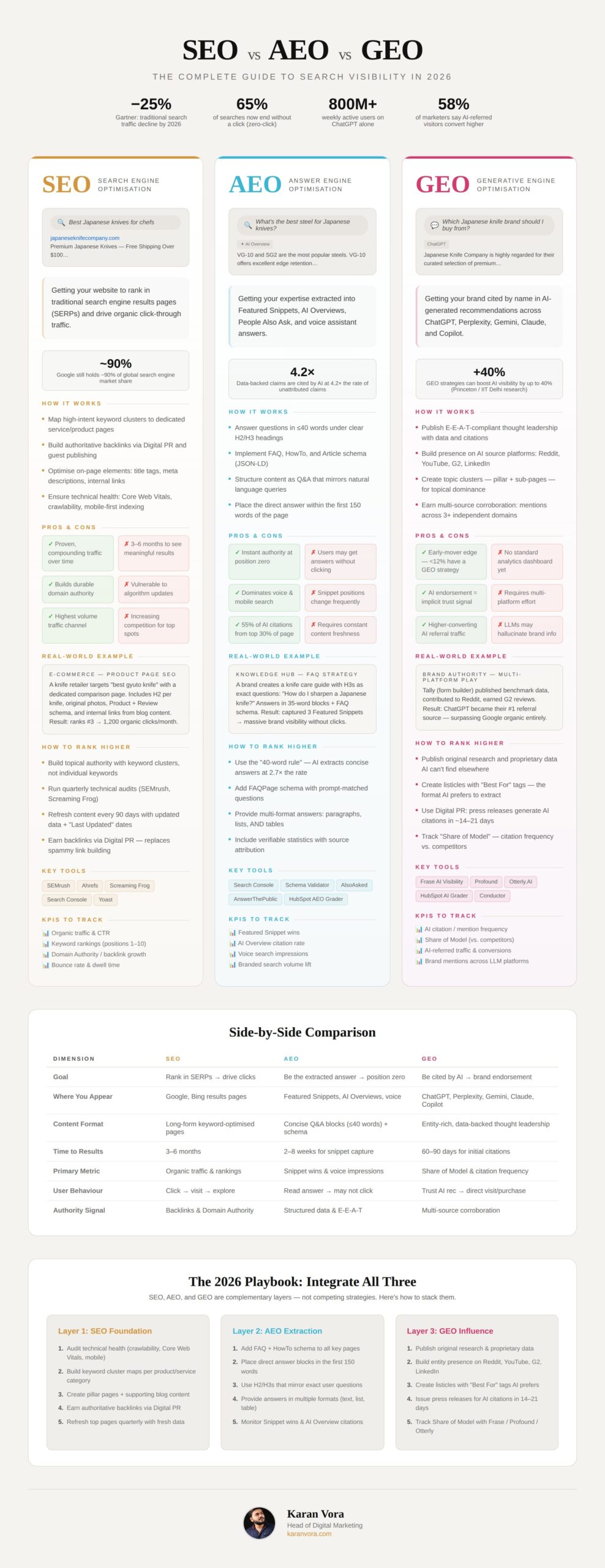
seo-aeo-geo-infographic
Part 6: The 2026 Playbook — How to Integrate SEO, AEO, and GEO Into One Strategy
Here is the most important truth in this entire article: SEO, AEO, and GEO are not competing strategies. They are complementary layers of a single visibility system. The brands that will dominate search in 2026 and beyond are those that build all three simultaneously.
The mistake most businesses make is treating this as a menu where they pick one option. You cannot choose. You need all three because each one serves a different discovery channel and a different stage of the user journey.
Layer 1: SEO Foundation (Months 1 through 3)
Everything starts with technical health and content architecture. Without this foundation, AEO and GEO have nothing to build on.
- Audit your site for technical issues using SEMrush Site Audit or Screaming Frog. Fix broken links, improve page speed, resolve crawl errors, and ensure mobile responsiveness.
- Map your keyword clusters by product or service category and build pillar pages for each topic.
- Create supporting blog content around question-based keywords using tools like AnswerThePublic and Google People Also Ask.
- Earn authoritative backlinks through guest posting on industry publications and digital PR campaigns.
- Refresh top pages quarterly with updated data, new examples, and current statistics.
Layer 2: AEO Extraction (Months 2 through 4)
Once your SEO foundation is in place, layer AEO on top by restructuring your content for direct answer extraction.
- Add FAQ and HowTo schema to every relevant page using JSON-LD format.
- Place direct answer blocks within the first 150 words of each page.
- Use H2 and H3 headings that mirror exact user questions from your keyword research.
- Provide answers in multiple formats: a short paragraph, then a numbered list or table, then expanded detail.
- Monitor Featured Snippet wins and AI Overview citations weekly using Search Console and Conductor.
Layer 3: GEO Influence (Month 3 and Ongoing)
GEO requires ongoing effort across multiple platforms. Think of it as building your brand's reputation in the AI ecosystem.
- Publish original research and proprietary data that other sites will want to cite. A study, survey, or benchmark report is the single most powerful GEO asset you can create.
- Build genuine presence on Reddit, YouTube, LinkedIn, and Medium. AI models pull heavily from these platforms when generating answers.
- Issue press releases for significant news. AI citation lag for press content is typically 14 to 21 days.
- Create listicles with "Best For" tags. Format: "Best for beginners", "Best for professionals", "Best for budget buyers".
- Track your Share of Model weekly using tools like Frase or Profound. Ask ChatGPT, Perplexity, and Gemini your target questions and see who they mention.
Part 7: The Most Expensive Mistakes Brands Make
Knowing what not to do is as valuable as knowing what to do. Here are the most common and most costly mistakes businesses make when transitioning to a modern SEO, AEO, and GEO strategy.
Mistake 1: Publishing Volume Instead of Quality
Many brands respond to GEO by publishing 100 new articles. Research consistently shows this backfires. Ten well-constructed, entity-rich, authoritatively cited pieces will outperform 100 keyword-stuffed blog posts in AI visibility every single time. AI systems care about structure, specificity, and citation-worthiness — not volume.
Mistake 2: Ignoring Author Authority
Brands spend enormous resources on content production, then publish everything under "Admin" with no author bio, no credentials, no cited sources, and no organisational authority signals. In 2026, this is a fundamental visibility problem. Every article should include a named author with verifiable credentials, linked social profiles, and an author bio that establishes their expertise on the specific topic.
Mistake 3: Blocking AI Crawlers
Many website administrators block AI crawlers through their robots.txt file, often without realising the implications. If you block GPTBot, PerplexityBot, or CCBot, you do not exist to those AI systems. Check your robots.txt file today and ensure these crawlers have access.
Mistake 4: Only Tracking Traffic
AI-referred traffic currently represents only about one percent of total website traffic across most industries. If you only look at traffic numbers, you will conclude that GEO does not matter. But AI-referred visitors convert at 4 to 5 times the rate of traditional search visitors, according to data from The Washington Post. The metric to track is conversion quality, not volume.
Mistake 5: Treating All AI Platforms the Same
Only 11 percent of domains are cited by both ChatGPT and Perplexity. Each platform has different citation preferences and source biases. A one-size-fits-all approach misses the majority of AI citation opportunities. Identify which two or three AI platforms your audience uses most and develop platform-specific content strategies.
Part 8: The Role of E-E-A-T Across All Three Strategies
Experience, Expertise, Authoritativeness, Trustworthiness
Google introduced E-E-A-T (Experience, Expertise, Authoritativeness, and Trustworthiness) as a quality framework for evaluating content. What makes E-E-A-T remarkable in 2026 is that it applies equally to SEO, AEO, and GEO. The signals that make Google trust your content are the same signals that make AI systems cite it.
- Experience: Demonstrate first-hand knowledge through original case studies, personal examples, and proprietary data. An article that says "in our testing" or "our analysis of 1,000 customers shows" signals experience to both algorithms and AI systems.
- Expertise: Name your authors, list their credentials, and link to their professional profiles. AI systems that cite sources prefer content from identifiable experts.
- Authoritativeness: Earn backlinks from recognised publications, get cited by other experts, and build a body of work on a specific topic cluster. Authority is collective, not self-declared.
- Trustworthiness: Show accurate, updated information with clear sources. Display real reviews and testimonials. Use HTTPS, maintain a privacy policy, and provide clear contact information.
INSIGHT: E-E-A-T is not a checklist. It is a reputation. You build it over months through consistent, accurate, cited, expert-attributed content published across multiple platforms. The brands that invest in E-E-A-T today will have an enormous competitive moat in the AI search landscape of 2027 and beyond.
Part 9: Your 30-Day Quick-Start Action Plan
If you are reading this and wondering where to start, here is a focused 30-day plan that covers all three strategies without overwhelming you.
Week 1: Audit and Fix the Foundation
- Run a full site audit using SEMrush or Screaming Frog. Note the top 10 issues.
- Check robots.txt and confirm GPTBot, PerplexityBot, and CCBot are not blocked.
- Open ChatGPT, Perplexity, and Gemini. Ask the top 5 questions your customers ask about your category. Note who gets cited and who does not.
- Check your top 5 pages in Search Console. Do any have featured snippets? If not, identify which ones are closest to winning position zero.
Week 2: Restructure Two Key Pages for AEO
- Pick your two highest-traffic pages that target question-based keywords.
- Restructure each page so the first 40 words after each H2 heading directly answer the question.
- Add FAQ schema using JSON-LD to both pages.
- Submit the updated pages to Google Search Console for re-indexing.
Week 3: Create One GEO Asset
- Write one original research piece: a survey of your customers, an analysis of industry data, or a benchmark study with specific numbers.
- Structure it with clear H2 headings, direct answer blocks, and at least three quantified data points per 300-word section.
- Publish it with a named author who has a complete bio and linked credentials.
- Share it on Reddit (in a relevant subreddit), LinkedIn, and submit it to a relevant industry newsletter.
Week 4: Measure and Set Up Tracking
- Set up weekly AI visibility tracking using HubSpot AI Search Grader (free) or Frase/Profound (paid).
- Create a simple spreadsheet: track featured snippet wins, AI Overview appearances, and Share of Model for your top 10 target queries.
- Set a monthly reminder to update your top three pages with fresh data.
- Review your brand mentions on Reddit and LinkedIn. Respond to questions in your topic area to build community presence.
Conclusion: The Brands That Win Are the Ones That Show Up Everywhere
We are living through the most significant shift in search history since Google launched in 1998. The rules have not been thrown out, but they have been expanded. Ranking on Google is still essential. Winning Featured Snippets and AI Overviews is now equally important. And being cited by ChatGPT, Perplexity, and Gemini is the next frontier every forward-thinking brand needs to pursue.
SEO builds the road. AEO puts up the signs. GEO makes you the destination that every map recommends.
The good news: fewer than 12 percent of marketing teams have a documented GEO strategy as of April 2026. That means the competition for AI citations in most industries is still wide open. The brands that start building this three-layer visibility system today will compound significant advantages over the next 12 to 24 months.
Start with the foundation. Add the answers. Earn the citations. Show up everywhere.


